The rules of exponents (sometimes called the laws of exponents) allow us to simplify expressions by using our understanding of what an exponent means in much the same way that combining like terms uses the idea of what multiplication means. In both cases, we want to eliminate any extra/unnecessary information and literally make whatever we have in front of us simpler (while making sure we didn’t change the meaning!) Why write 5^{2}4^{3}5^{8}4^{2} when you could write 5^{10}4^{5}?

As a brief reminder, an exponent tells you how many times to multiply a number, variable or expression times itself. For example:


x^4=x \cdot x\cdot x\cdot x

(x+5)^3=(x+5)(x+5)(x+5)

All of the rules require that the terms have the SAME BASE. The base is whatever is being taken to a power. Above, x is the base in the first example and x+5 is the base in the second example.

When multiplying two terms with the same base, add the exponents

x^{m}x^{n}=x^{m+n}

For example, x^{9}x^{3}=x^{9+3}=x^{12}.Why does this work?

If I have 3^43^2, this means to multiply 3^4 by 3^2. But, 3^4=3\cdot3\cdot3\cdot3 while 3^2=3\cdot3. Looking at the original example, 3^43^2 = (3\cdot3\cdot3\cdot3)(3\cdot3) and if you count the number of 3′s being multiplied, there are 6 – so really, this is a complicated way to write 3^6.

When dividing two terms with the same base, subtract the exponents

\dfrac{x^m}{x^n}=x^{m-n}

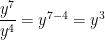
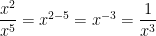
For example, \dfrac{y^7}{y^4}=y^{7-4}=y^3 and \dfrac{x^2}{x^5}=x^{2-5}=x^{-3}=\dfrac{1}{x^3}. Why does this work?

Just as I did before, I’m going to use the basic idea of an exponent to see this rule in action. Take for instance, \dfrac{5^4}{5^2}. This can be rewritten by writing out the mulitplication \dfrac{5\cdot5\cdot5\cdot5}{5\cdot5}. At this point, I can cancel any factors that are shared by the numerator and the denominator and I am left with \dfrac{5\cdot5}{1}=5^2. The “rule” is essentially doing this work for us by subtracting. If I had used the rule here I would have \dfrac{5^4}{5^2}=5^{4-2}=5^2. While I think this is useful, I have always found that it can be more useful to use the idea of cancelling factors directly. As with a lot of math “problems” though, it depends on the situation.

When taking a “power to a power”, multiply the exponents

(x^m)^n=x^{mn}.

For example (x^4)^4=x^{16}. Why does this work?

Alright, let’s use another example say – (8^2)^3. If an exponent tells me how many times to multiply something by itself, then this means to multiply 8^2 by itself 3 times: 8^28^28^2. Now, we have three terms with exponents multiplied that all have the same base. This is the first rule of exponents so I know to add them: 8^28^28^2 = 8^6. This is the same thing I would have found if I had multiplied the 2 and the 3.

Now that we have those down, a few things to keep in mind when you start using them:

Related Posts:

  • No Related Posts

Need more algebra help? Thinking of getting a tutor?
Our online algebra bootcamp is an expert guided 7 day review with more videos, practice, and quizzes!


, ,

No Comments

Add your comment now